| This article is for the original PlayStation 2 release. For the Xbox version released in the next year, see Fatal Frame: Special Edition. |
| Fatal Frame | |||
|---|---|---|---|
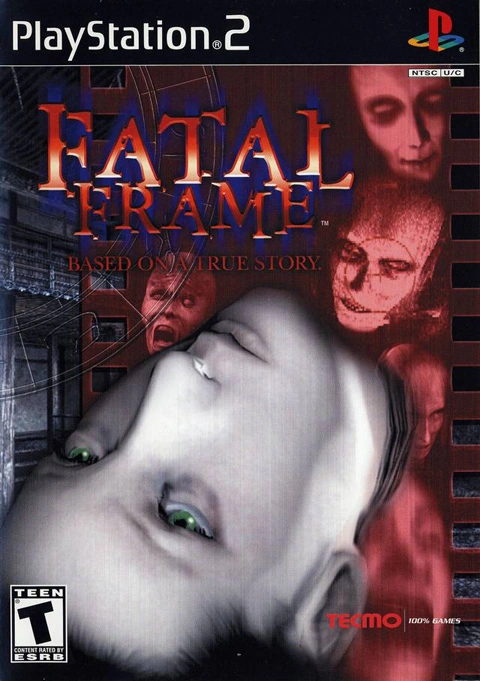 | |||
| 零 Zero Project Zero | |||
| Developer(s) | Tecmo, Ltd. | ||
| Publisher(s) | Tecmo, Ltd. (Jap.) Tecmo, Inc. (US) Wanadoo Edition (Europe) MC2-Microids (Poland) Sony Computer Entertainment America, Inc. (PSN release, US, Canada) | ||
| Release date(s) | December 13, 2001 (Jap.) March 04, 2002 (US) August 01, 2002 (PlayStation 2 the Best release, Jap.) August 30, 2002 (UK, Italy) September 03, 2002 (Austria, Germany, Switzerland) October 09, 2003 (Poland) November 22, 2007 (PlayStation 2 the Best reprint, Jap.) April 09, 2013 (PSN release, US, Canada) | ||
| Ratings | Teen (ESRB) CERO C (15+) (Jap.) 18+ (ELSPA) | ||
| Platform | Playstation 2 | ||
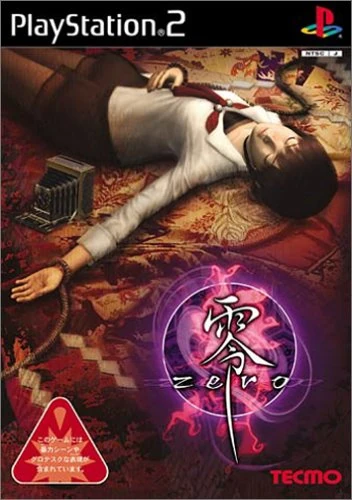
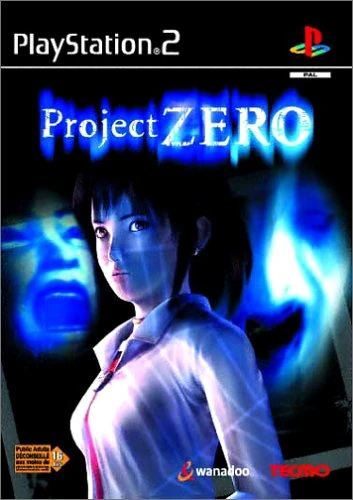
| “ | Unravel the mystery... | ” |
—Fatal Frame | ||
Fatal Frame, also known as Zero in Japan and Project Zero in Europe, is a Japanese survival horror game and the first installment in the Fatal Frame series. It was initially released for the PlayStation 2, and later for the Xbox. The PlayStation 2 version was developed and published by Tecmo on December 13, 2001, in Japan, and on March 4, 2002, in North America. It was published by Wanadoo on August 30, 2002, in Europe. The game was re-released as a "PlayStation 2 Classic" on the PlayStation Network for the PlayStation 3 on April 9, 2013, in North America. The game's unique premise of fighting ghosts with a special camera was introduced in this first game of the Fatal Frame series. A Special Edition was also released on the original Xbox in Japan.
Synopsis
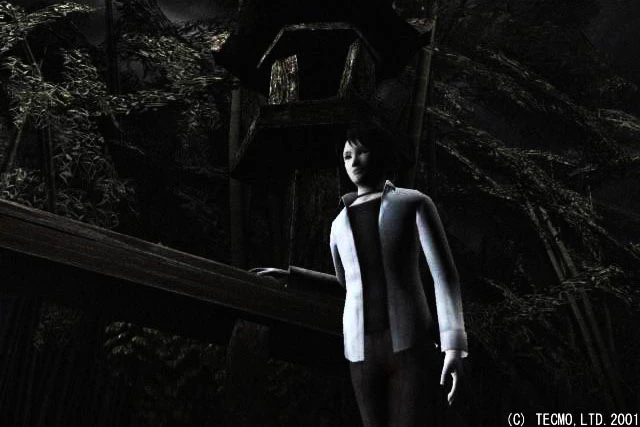

Mafuyu approaches the Himuro mansion.
Set in 1986, the story of Fatal Frame begins with Mafuyu Hinasaki, an aspiring folklorist who decides to investigate the allegedly haunted Himuro Mansion one night in search of renowned folklorist Junsei Takamine. Mafuyu brings with him a family heirloom, a special camera with the power to "expose things the normal eye can't see." He discovers that the ghosts of those who have perished in the mansion are roaming the empty halls. After fending off a violent ghost and witnessing the power of the camera for himself, Mafuyu decides to continue his search. However, as he attempts to return to the entrance hall of the mansion, a dark presence surrounds him, and Mafuyu's fate becomes unknown.
Two weeks later, Mafuyu's sister Miku arrives at the mansion, fearing the worst for her brother. She takes it upon herself to enter the mansion and find him. Inside, she finds the camera that Mafuyu brought with him, and as she continues his investigation, she discovers the truth about the folklorist who went missing. Takamine came to the mansion to research the grisly events that occurred there long ago, and in his progress, he uncovered the mysterious Strangling Ritual that took place in the mansion. But before he and his assistants could leave the haunted grounds, they were attacked by the spirits that were killed in the aftermath of the failed ritual. Miku continues deeper into the mansion, determined to find the truth and her missing brother. The story becomes only more harrowing with every room Miku enters, and later on, she finds out that the ghostly Shrine Maiden is also looking for Mafuyu.
Plot
- For more details see: Fatal Frame Nights
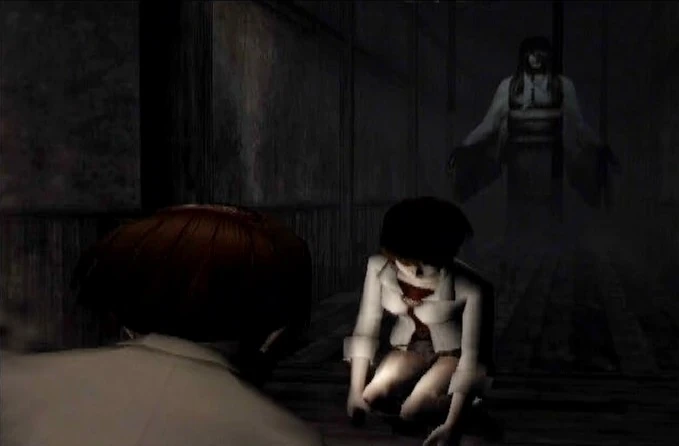

The Rope Shrine Maiden pursues Miku.
During her time in the mansion, Miku sees various apparitions of her missing brother, leading her toward solving the mystery of the mansion. Eventually, Miku learns that the Himuro Mansion was the site of many horrific rituals, the main one being the Strangling Ritual, designed to keep the Hell Gate located beneath the mansion closed and protect the region from harm. The ritual required a woman within the family to become the Rope Shrine Maiden, who was selected and hidden away for ten years with little contact with anyone, so she would have no attachments to the world.
Beneath the mansion is an expansive cavern where the final acts of the ritual are carried out. The Rope Shrine Maiden is purified and taken to a large stone pedestal, where five ropes are tied to her limbs and neck. The ropes are connected to five pillars, symbolizing the five head families of the surrounding region. These pillars are turned, causing the maiden great pain until her limbs are torn from her body. The ropes, stained by the sacred blood of the sacrificed maiden, are then used to tie the doors of the Hell Gate closed, thus preventing the Malice within from escaping and causing catastrophe.
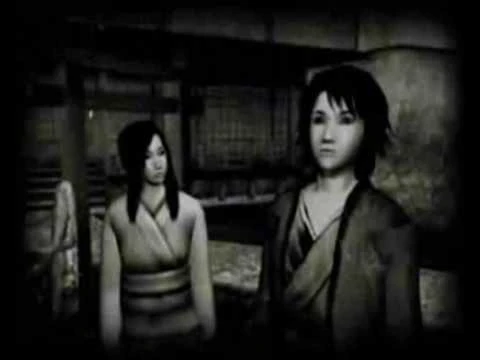

Kirie, meeting her lover in the mansion's cherry atrium.
The ritual failed, however, and the disaster known as The Calamity occurred when the last Rope Shrine Maiden, Kirie Himuro, failed to sever her attachments to the world. While she was isolated within the mansion, Kirie met and fell in love with a man who stayed at the mansion and bore a striking resemblance to Mafuyu Hinasaki. The Himuro family began to fear her growing attachment, and after confining her to her room, the family master ordered the man to be killed. Kirie learned of his death before the final moments of the ritual, and her regrets caused the ritual to fail. The Malice poured forth from the gate, killing most within the mansion and driving the rest mad. The Malice attached itself to the spirit of Kirie, twisting her into a vengeful ghost bent on making others experience the pain and misery she went through.
Apart from the ghost of the Rope Shrine Maiden, there was the spirit of a Girl in a White Kimono, who guided Miku along her investigation. This was the embodiment of Kirie's innocent self, tied to her sacred duty as the Rope Shrine Maiden. Ever since the Malice erupted from the Hell Gate, the mansion had been trapped in darkness, and the souls of all who perished inside were unable to rest. Junsei Takamine and his assistants, Koji Ogata and Tomoe Hirasaka, were caught in the darkness upon setting foot inside, and they fell to Kirie's wrath. They were cursed with the same gruesome fate that befell the Rope Shrine Maiden and became violent ghosts themselves. When Mafuyu entered the mansion, he became trapped as well, but because he resembled Kirie's lover, he was allowed to live.
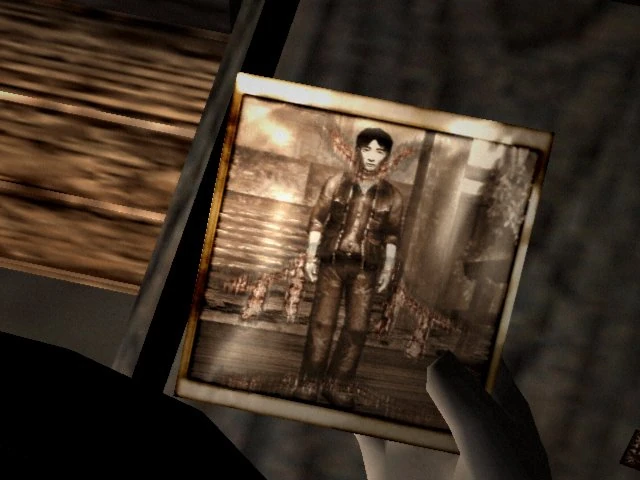

The curse of the strangling ropes on Koji Ogata.
After being trapped inside the Himuro grounds, Miku nearly fell to the curse of the strangling ropes, but on the fourth night, she took the final path of the Rope Shrine Maiden and found Mafuyu before the Hell Gate. They called out to each other, but before Mafuyu could reach out to Miku, Kirie pulled him back, saying, "We will always be together." Miku used the powers of the Camera Obscura to exorcise Kirie's ghost, but she was overpowered, and the camera was thrown to the ground and broken. Before succumbing to the malicious ghost, Miku saw the girl in the white kimono point towards the broken camera. She was really pointing at the shining fragment that came from within the camera, the final piece of the Holy Mirror, which Miku could use as a last resort against the Malice. Miku had uncovered all of the other pieces while searching the mansion, and after assembling them, she was able to banish the evil that possessed Kirie, freeing her spirit and Mafuyu from the Malice.
Endings
- Main article: Fatal Frame endings
There are three possible ending scenes that play after completing the game. The second scene is only available after beating the game in "Nightmare" mode. The third ending can be obtained on the Xbox release by completing the game on "Fatal" mode.
Gameplay
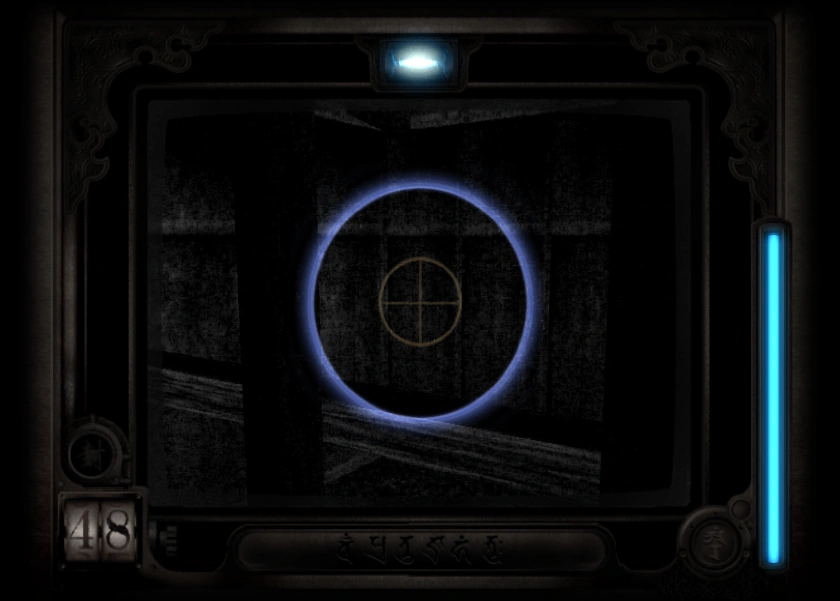
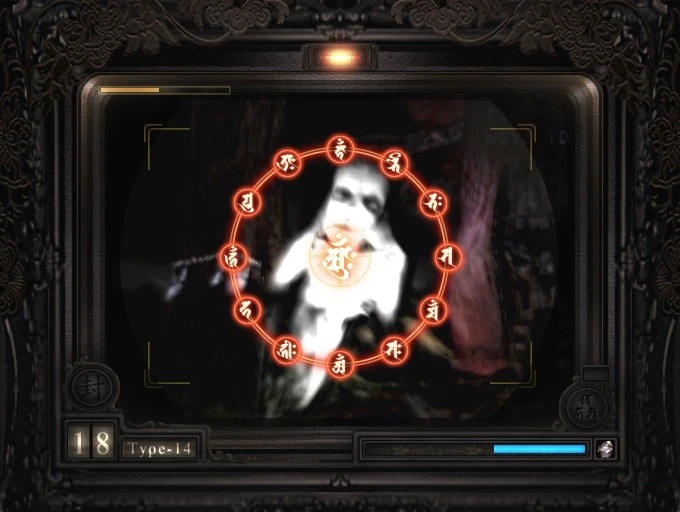
Fatal Frame was the first game to introduce the innovative use of an old-style camera as the primary weapon. In addition to navigating the main characters around the mansion grounds, players can enter Viewfinder Mode, where the camera is raised, and the view changes to that of the camera's frame. In Viewfinder Mode, the player can snap photographs of ghosts, both violent and benign, which is the primary method of progressing through the game.
Items are also available in the game, some being consumable and most being key items needed to unlock doors, complete tasks, or solve puzzles. Puzzles are encountered frequently in the game, some recurring but with increased difficulty. The varying difficulty settings of the game (Easy, Normal, Hard, Nightmare, or Fatal (Xbox only)) determine the amount of consumable items scattered throughout the mansion and how formidable the enemies are.
The mechanics programmed for the ghosts allow them to float ethereally through the air, walls, and floors, and even teleport, giving them many ways to attack the player. The ghosts' appearances are usually inspired by their deaths or by Japanese horror.
Depending on the console played on, the game offers two or three endings. Upon completion of the game, a ranking is given based on the total time taken, points accumulated, and other categories. The player is also rewarded with unlockables, such as alternate costumes and camera functions, depending on what difficulty was beaten, how much of the Ghost List was completed, and other criteria. Beating the game also unlocks Battle Mode, where the player faces specific ghosts and earns points towards purchasing unlockables. An option is also given where the game can be replayed with all equipment, upgrades, and unlockables carried over.
Xbox gameplay
The Xbox release of Fatal Frame included many changes, the largest of which was the addition of a new ending and a new difficulty setting (Fatal). The appearance of the camera's viewfinder mode was also revamped, and more hidden ghosts, diaries, and unlockables were added, as well as an optional battle with a brand new ghost during the game's final night.
Sealing spirits
The idea of a camera absorbing ghosts is based on the superstition that having your picture taken steals your soul, and the only way to return it is to burn the film. Some religions and cultures still believe in this today, including some places in Mexico. The ghosts encountered in the game are all lost souls.[1]
Development
The concept for the game came to the future director, Makoto Shibata, shortly after he finished working on Tecmo's Deception: Invitation to Darkness. Shibata was inspired by his own dreams and encounters with what he felt were supernatural occurrences. Development began when the PlayStation 2 hardware was first introduced to Tecmo, under the codename "Project Zero." One of the things they drew inspiration from was the positive reception of polygon characters in the Silent Hill series. They used this as a starting point and created the sense of seeing things off-screen, aiming to create as frightening an atmosphere as possible. The staff included multiple developers from the Deception series.
According to character designer and CGI director Jin Hasegawa, the game's key colors are black and white. White represents hope, while black represents fear. During early development, a large amount of effort went into adjusting the lighting and shading. The most obvious in-game representation of the key colors and desired effect is Miku's torch piercing the darkness inside the mansion. In addition to black and white, a third key color represented through Miku's clothing was red, representing life.
The composer and sound director was Shigekiyo Okuda. One of the main concepts during the game's concept development was using stereophonic sound to reinforce the atmosphere. Due to the nature of the project, Okuda considered it important to convey a three-dimensional feeling using sound projected from both left and right. After testing out multiple middleware and commercial sound tools, the team settled on Arnis Sound Technologies.
The setting of the game in a classical Japanese mansion originated from Shibata's early ideas for settings within the Deception series. However, these ideas were passed over as it limited the possibilities for the series' trap-setting gameplay. When creating the atmosphere, the team watched both high and low-budget Japanese horror films and war films. The story was the first part of the game to be completed, and the setting was originally going to be in the then-present day. However, as the team wanted to create a feeling of isolation through a lack of modern technology such as mobile phones, the setting was changed to the 1980s.
Some scenes were considered too graphic for the game and were cut. Two cited examples were a flashback showing the head of the Himuro house committing seppuku, and another was a scene showing Kirie being torn apart during the Strangling Ritual. The way the Holy Mirror was broken also made a deliberate reference to how the ritual pulled the body into five pieces. While rituals form a core part of the story, the development team had little to no experience with such things. For inspiration, Shibata used similar motifs of spirituality in Yōkai Hunter, a manga written by Daijiro Morohoshi.
The Camera Obscura was not in the initial discussions between Shibata and Kikuchi. The original idea was that ghosts would be avoided and repelled by light. Ultimately, they decided to have a type of offensive power, which resulted in the Camera's creation. Kikuchi was initially opposed to the idea, but saw that it fitted very well into the game's context as development progressed. The Camera's design was based on a German military camera.
The PlayStation 2 interview
An interview with Makoto Shibata (director), Keisuke Kikuchi (producer), and Hitoshi Hasegawa (also known as Zin Hasegawa, character design director) was published in the December 21st issue of Softbank's Weekly "The PlayStation 2." The interview is as follows:
Fear is one of the emotions everyone has
Kikuchi: I think fear is an emotion shared by all people. So that more people would be able to enjoy it, we decided to make it a horror game. Previously, when we came up with the Deception series, its two selling points were its dark atmosphere and new game system, but with series we went one step further with the "fear" theme, and that's how it began.
-With regards to the Japanese-style elements, how was that chosen?
Kikuchi: I think those who encounter Japanese styles in everyday life - in other words, Japanese people - will interact better with it. During the game, crazy - or, rather, unusual things - happen, since it's mixed with everyday things which are also shown in the game, we chose the Japanese style thinking it might evoke empathy.
Shibata: In a Japanese house, in the shadow of a sliding door or under a surrounding edge, is the kind of darkness that makes you think something could be lurking there. Wanting to express that darkness, the Japanese style was chosen.
-It is a space that incorporates the peculiarities of Japanese culture. Come to think of it, right after the introductory articles started being written, the current details of the game's opening have changed quite significantly, haven't they?
Kikuchi: Yes, they have.
-What has been changed?
Kikuchi: It was because we wanted to make it a little clearer during the introduction, which serves as the tutorial, why the protagonist has entered the mansion. Then, since getting out of the car and going into a Western-style hall is a situation too similar to so many other games... The ghosts I saw as a kid had little effect (laugh)
Shibata: Considerably effort was put into the ghosts. They're the opposite of the ghosts I saw as a child, which had little effect on me.
-It's great that you've seen ghosts, but you've not seen anything that had much of an effect? (laugh)
Kikuchi: When we were talking about how to present the ghosts, Shibata's mysterious comment was, "Let's realise the ones I saw in my dream."
Hasegawa: His words were relayed to the staff with expertise in the effects area, and they kept determinedly working.
-So as to realise the ideal ghosts.
Shibata: But the ghosts I see in my dreams have become stronger. At first I won, but in the dreams I've had lately the ghosts have such a powerful effect that I think, "Uh oh, these guys might beat me" (laugh).
Hasegawa: Since the effects were used in such a way that they're repeatedly layered, the way it's processed makes it look seriously bizarre.
Kikuchi: It was really well cut.
-There does seem to have been a lot of concentration on the ghosts. When TV shows and films that deal with a spiritual theme are made, the staff go to purification ceremonies - did you go to any?
Kikuchi: I tried to get one together, but though I begged Shibata, saying, "We won't be scared if we go to one," he told me off wouldn't let us go (laugh).
Shibata: I didn't tell you off... (laugh)
Kikuchi: Okay, well, you didn't exactly forbid us, but you said there was no need for such a thing. There was one person amongst the staff who really believed in the curse, and they would come into work with a charm hanging around their neck for protection.
Shibata: Though I said, "It's alright, we don't need a purification. It wouldn't stop you being scared somehow," they still stuck up an ofuda talisman, just in case. But for some reason, whenever they went to sit in their seat, they'd take it down...
-No one was actually cursed, though, right? They would just end up with sudden high fevers, and things like that.
Shibata: Do you not think that the fever was caused by the curse? (laugh) But, I have heard stories of things like being patted on the head in the middle of the night, and having their hair pulled.
Kikuchi: Well, they're quite trivial, and since everyone was making the game with such feelings, there are also some questionable parts.
Shibata: Though there was no female presence in my room, a woman's hair was left all over the place, things like that.
Kikuchi: Oh, that's right. But I still have doubts about that... (both laugh)
-Did you use any novels, films or anything else for inspiration?
Kikuchi: We did a lot of research. Of course we watched Japanese horror films, both major and quite old, low-budget ones. To bring out the fear, we wanted to express it in a film-like representation, so we also used old war films for reference.
Shibata: At first we discussed making it so that you couldn't defeat them, and had to use the torch to repel them and then run away, or that you could use ofuda or a Hamaya to defeat them - we had lots of ideas like that, but we came up with the concept that "controlling the fear until the very last second and defeating it - that's what horror until now has lacked", and thought a camera suited it.
There are lots of traditions involving cameras that take pictures of ghosts, and suck in people's souls, so I thought there must be something quite spiritual about them. We also agreed that if we were going to make something new, it had to use a concept no one had used before.
-Was camera customisation also an element that was there from the very beginning?
Kikuchi: Since there's no element of the protagonist growing, the feedback from battle goes into the camera she has. I think comfort was expressed in the moments surpassing fear
-It's perceivable that quite a lot of effort was put into making the events scary.
Kikuchi: That was largely due to Shibata's sensitivity. Though he's liable to get quite carried away, he would often say that he found it soothing.
Shibata: This has also been written about on the website, but it's based on my own fearful experiences. The rest I saw I dreams and the like.
Kikuchi: For example, at first he couldn't convey the ghost's movements to us, so there were times when he would do the motion capture (laughs). As you would expect, if he didn't think it was good enough he would get an expert to do it. That should give you an idea of what was always happening - Shibata really checked everything in this game with great scrutiny.
Shibata: Since we also put considerable effort into the sounds and things like that, including the pseudo-surround sound, I would want to play it in a dark room while wearing headphones.
-Then finally, heading towards the release date, is there any message you would like to give to people?
Hasegawa: We also tried hard in the movie scenes, making searching around in the dark with the torch scary. I also think we wonderfully expressed the balance between light and dark while compromising with the ghosts, so please check it out.
Shibata: Though it might sound strange, it's a game in which the idea of "comforting darkness" has been skillfully done. It incorporates many elements, so I think it might take a while to play. In any case, please stick with us in the future.
-You said "comfortable"?
Shibata: Though it might be a bit of a strange story, but when I'm in actual "psychic spots" and the like - not haunted houses at amusement parks or anything like that, though - I feel somehow comfortable. For some reason, places like that make me feel comfy and at ease.
Hasegawa: That is really strange.
Shibata: Or rather, calm, perhaps. But anyway, these "psychic spots" give off such a unique atmosphere. If I'm there for quite a while, I suddenly become distinctly comfortable, like being drawn into and going to the other side, and I think we managed to put that atmosphere into the game.
Kikuchi: It was made to be sufficient both as a horror game and as an action game, so I think that I would like people to enjoy it from both angles.
-Thanks for your time.
Release
Regional changes
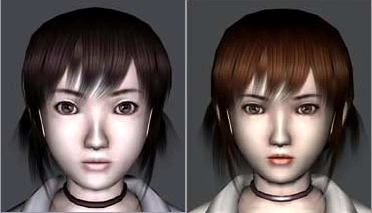

A comparison of Miku's face in the Japanese (left) and American (right) releases.
Other than the obvious name change, other aspects of the game underwent editing for release in regions outside of Japan. The term "Fatal Frame" itself was not introduced until the overseas release, prompting the name change. Another prominent change was in Miku's character design. The large red bow over Miku's shirt (much like those seen in Japanese school uniforms) was removed, and the shirt underneath was made more red to compensate. Miku's face was also edited, giving her slightly smaller eyes and redder lips, and her hair was changed to a more vibrant brown color. The new model was used for all subsequent releases, including the Japanese Xbox edition.
Reception
Critical response
| Publication | Score |
|---|---|
| 1Up.com | B+ (PS2) |
| AllGame | 3.5 out of 5 Stars |
| Eurogamer | 9/10 (PS2)
8/10 (Xbox) |
| Famitsu | 32/40 (PS2) |
| GamePro | 3.5/5 (PS2)
3/5 (Xbox) |
| GameSpot | 7.1/10 (PS2)
7.7/10 (Xbox) |
| IGN | 7.9/10 (PS2)
7.7/10 (Xbox) |
Famitsu praised the use of the Camera Obscura in creating a sense of tension in combination with the sound and visual design. IGN's David Smith, while noting some difficulties with the controls, generally praised its atmosphere and gameplay, saying that "horror fans are advised to pick this one up at their leisure, and even the jaded might find something to renew their interest in the genre
Chris Baker of 1UP.com similarly praised the atmosphere and enjoyed the gameplay, particularly noting its ability to make him feel like a newcomer to gaming with its late-game difficulty spike
GameSpy's Raina Lee, reviewing the Xbox version, called it "the only really scary game on the Xbox"
Eurogamer's Rob Fahey, while initially wary of the game, was impressed by the game, calling it "compelling and utterly addictive" and citing multiple parallels with Ring.
Chris Hudak of Game Revolution particularly praised the game's atmosphere, but faulted the Camera Obscura's need for ghosts to be within the targeting area to score points, and some over-familiar elements similar to other horror games of the time
GameSpot's Miguel Lopez was generally positive, enjoying the game despite faulting some of the textures and particle effects: in conclusion, he said that fans of the Resident Evil and Silent Hill series would enjoy the game.
Sales
Fatal Frame was released in Japan on December 13. Based on Famitsu's software sales chart, Fatal Frame debuted at 15th place selling 21,770 units in its first week in Japan,[2] and would later go on to sell just over 42,000 units in 2001. Globally, Fatal Frame sold 70,000 units in North America (49.0%), 60,000 units in Europe (38.2%), and 20,000 for the rest of the world (12.8%).
As of February 21, 2015, 140,000 units were sold.[3]
Controversies
The cover of the overseas release of Fatal Frame contained the tag line "Based on a true story," however, the validity of this claim is questionable. The plot of the game is allegedly based on legends surrounding a Himuro Mansion found outside of Tokyo, Japan. Stories are told of the gruesome deaths of the family and inhabitants of the decades-old mansion, however, series producer Makoto Shibata has said that the real-life mansion was not the basis for the game's plot. Instead, Makoto Shibata cited two old Japanese urban legends as the game's main inspiration, rather than the stories of the Himuro mansion murders. Further, the "Based on a true story" tag line was not explicitly advertised during the game's Japan release, and was only added upon its release outside of the country.
Makoto Shibata described the actual inspiration for the game’s haunted house in an interview:
- "In an area outside Tokyo, there lies a mansion in which it’s said seven people were murdered in a grisly manner. On the same property, there lie three detached residences that surround the mansion, all of which are rumored to have ties to the mansion’s troubled past. It’s said there is an underground network of tunnels that lay beneath the premises, but nobody knows who made these tunnels or what purpose they served. Many inexplicable phenomenon have been reported occurring on the property. Bloody hand prints have been found splattered all over the walls. Spirits have been spotted on the premises...even in broad daylight! A narrow stairway leads to an attic where a spirit-sealed talisman is rumored to be locked away. Men have sought this talisman, only to be found later with their bodies broken and rope marks around their wrists. There’s a crumbling old statue of a woman in a kimono, but its head is missing. If you take a photo of a certain window, a young girl can be seen in the developed picture. These incidents have provoked fear in the people of Tokyo, and many believe that those who live near this area will become cursed. The deaths of those seven people are unexplained to this day."[4]
Additionally, the developer of Fatal Frame, Tecmo, was quickly sued by the movie company behind Ghostbusters, claiming that the idea of capturing ghosts in a camera infringed upon the concept of Ghostbusters. The case was later dropped.[5]
Novelization
A Japanese-only novelization of the game, Zero Novel, is available on Amazon.jp (ISBN 4840220654[6]). It is told from the viewpoint of Mafuyu Hinasaki, and its storyline differs slightly from the original game.
Trivia
- The title "Fatal Frame" was only introduced in the overseas release of the game as a special camera shot. In the original, the equivalent camera shot was named "Zero" shot, which was consistent with the Japanese title.
- Fatal Frame, being the first in the series, is the only game without a proper musical ending theme.
- Supposedly, the game is based around the true story and legends surrounding Himuro Mansion in Japan. The mansion is rumored to be the gruesome death site of a Japanese family and several of its associates a few decades ago. However, when asked, Makoto Shibata, the series producer, said the game was based on two old Japanese urban legends and ghost stories; he made no mention of the previous tales of the Himuro Mansion murders, which brings into question the factuality of this previous "basis" for the true story. It is also worth noting that the game was not explicitly advertised as being based on a true story in Japan, and that the "based on a true story" tag line was not used until Tecmo released the game outside of Japan.
- In Europe and Australia it is called Project Zero, this is widely believed to be a mis-translation of the Japanese name Zero, also Project Zero was the name of the team which designed the game.
- In some copies of the game for the PS2, there is a game breaking bug in which Mafuyu is unable to use the camera. It is impossible to advance without the use of the camera and there is no known fix for it rendering the game completely unplayable.
- Fatal Frame was referenced in the 2006 horror game movie Stay Alive.
- The font used in the North American logo of Fatal Frame 1 is Garish Monde by Dixie's Delights
- The font used in the Japanese logo of Fatal Frame 1 is C&G流麗太行書体 by C&G シーアンドジイ
Gallery
Promotional images


Box art and logos


.png "FF1 Logo (EU).png (301 KB)")